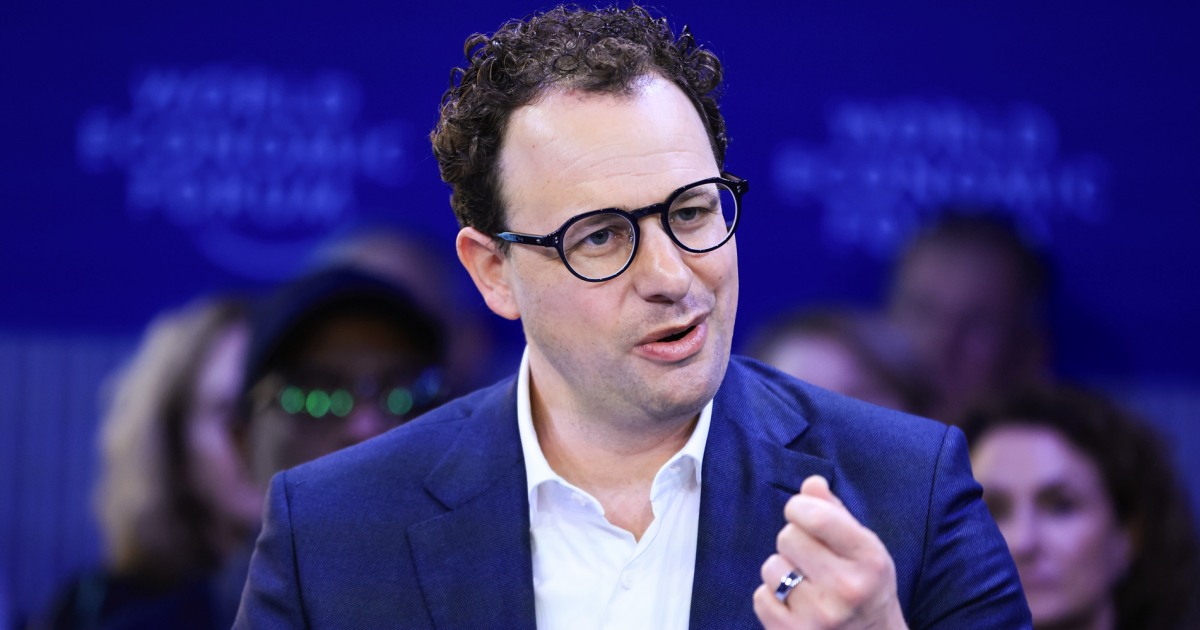
Oura CEO Tom Hale on giving the finger to health tech’s stereotypes

For years, health tech has sold the same promise in different disguises. Eat, sleep, train, repeat – a ritualized path toward the perfect self.
Tom Hale is not interested in that story.
As CEO of Oura, the company behind the minimalist smart ring worn on the index finger, Hale has helped steer the brand away from peak performance culture and towards something far less fashionable in tech: longevity. Not fitness for fitness’s sake, but fitness as a means of living better for longer.
That distinction has shaped everything from Oura’s advertising casting choices to its decision not to obsess over gym-body ideals, from its approach to influencers to its move to turn a single finger into a distinctive brand asset. It has also coincided with explosive growth, including a rapidly expanding and female-dominated customer base and a business on track to hit $1bn in annual revenue.
Health tech, as Hale sees it, has spent the past decade narrowing its definition of progress. More data. More discipline. Fewer excuses. Better bodies. The logic of grind culture, basically. It is a mindset built around performance and perfection – and one Hale believes has gradually boxed the category in.
“So much of tech is utility,” Hale tells The Drum when we meet at Web Summit in Lisbon. “But what’s interesting about a wearable is that you put it on your body. It’s expression. It’s clothing, in some ways. It’s saying something about you.”
That distinction between utility and meaning sits at the heart of Oura’s brand strategy. Its most recent marketing campaign did not depict the idealized body or high-tech features. Instead, it sold the dream of a product enabling a fuller life over time.
Longevity over performance
Hale is blunt about the cliches that dominate health marketing. “When you’re marketing health, there are sort of two ways,” he says. “One is young, healthy people – look at how healthy they are. Or here’s old, sick people.”
Oura rejected both. Its ‘Give Us the Finger’ campaign eschewed gratuitous lingering shots of washboard abs and health lectures in favor of character and relatability. Among those featured were George Papoutsis, a gray-bearded basketball trick shot artist lighting up courts across New York City, and Mónica Romero and Omar Ocampo, world-renowned Argentine tango dancers who met in Buenos Aires more than 40 years ago. These were not models of youth or physical perfection, but models of living well.
“What was really surprising was the reaction,” Hale says. “It wasn’t the elderly saying, ‘Oh, that’s such a great image of being old.’ It was exactly who we were hoping to reach, young people saying, ‘That’s who I want to be.’”
The thinking behind the work came directly from observing Oura’s users. “When Oura ring wearers spot someone else with a ring, they come up and say, ‘How do you like it? What are your scores?’ It’s an immediate kind of community.”
There was also a deeper cultural insight at play. “Young people right now are worried. They’re worried about the future. Financial concerns. Social concerns. The planet’s on fire. What we’re saying is, it’s going to be OK. You have some agency in how you live a good life. Find the thing that you’re passionate about.”
Longevity, by Oura’s definition, is not a medical claim or a biohacking fantasy. “It’s actually not about living longer,” Hale says. “It’s about living better.”
Applying that mindset to the brand’s advertising required it to treat authenticity as a discipline rather than a tone of voice.
“We were very intentional in the casting. Those people weren’t playing at those roles. That’s who they are.”
Streetball artist Papoutsis, for example, “is a legend of downtown New York,” Hale says. Romero and Ocampo were already culturally significant figures within tango, their partnership and longevity lending the work its emotional credibility.
“Consumers can detect the faintest whiff of inauthenticity. It just comes across as missing the boat.”
This doesn’t mean that Oura is rejecting those pursuing the perfect physique. Hale and his team are simply recognizing – and shrewdly, its year-on-year doubling of revenues would suggest – that it would be imprudent to limit itself exclusively to that audience. “For some people, the people who spend every minute of every day thinking about how to get ripped abs, that [chiselled image] is very inspiring,” he acknowledges.
The broad-church approach also gives Oura ammunition to naturally highlight a product benefit: namely, that its device tracks movement automatically. “So we talked about how every movement counts, whether you’re doing housework or you’re walking the dog. It’s scientifically supported. If you move more, you will be healthier. It doesn’t have to be carving out an hour to get your 10km run in. It could be anything.”
Want to go deeper? Ask The Drum
Owning the index finger
Brand codes, distinctive brand assets, fluent devices. No one can quite agree what to call them, not even Mark Ritson, but most marketers agree on their importance. Few brands can credibly claim ownership of a physical gesture. Oura has come close.
There is a functional reason the ring is worn on the index finger. As your heart pumps blood, that’s the finger that gets it first, making it the strongest to deliver back data. “Each successive finger, the signal is slightly weaker,” Hale explains. There is also a practical reason. “This part of the index finger is bigger than the knuckle,” he says. “You get the ring on, but you still have good contact.”
But accuracy is only part of the story. “Most people don’t wear rings on their index finger,” Hale notes. “So as a result, it’s very distinct. We’ve kind of trademarked that behavior.”
The visual impact has become central to Oura’s brand language. “Give us the finger was the first moment where we were really trying to make ownership of this,” Hale says. “You can see that red thread through all our campaigns.”
In a category crowded with wrist-based devices, Oura has carved out its own niche. “Lots of things are competing for this space,” Hale says, gesturing to his wrist. “Very little is competing here.”

The ring has also evolved into a form of self-expression. Ceramic versions, colorways and even a partnership with Gucci have pushed it closer to jewelry than gadgetry. “It’s not about joining a cult,” Hale says. “It’s about expressing yourself.”
That philosophy extends to how Oura approaches influence.
“When I first joined, we were doing what you might consider the typical things,” Hale says, referring to athlete influencers being paid for social posts and carefully choreographed endorsements.
“One of the first things that I did was [say], I think we should actually be more broadly inclusive and we should figure out how to make it more of an everyman story than these sort of aspirational icons. We backed that off. And what was interesting is that even though we backed it off, a lot of [athletes and influencers] use the product organically.”
Inside Oura, those sightings are logged in a channel called ‘Oura in the wild.’ Sports commentators wearing the ring on air. Athletes spotted mid-interview. Moments of recognition rather than persuasion. Pierre Gasly, the French F1 driver, was a recent addition to the canon.
“You know when you see somebody and you think, ‘I see you,’” Hale says. “It’s not artificial. It’s very natural.”
Women’s health and real growth
The most commercially significant outcome of Oura’s strategy has been its traction with women.
“Today, our combined base is about 70–30 women to men,” Hale says. “Three years ago, it was the other way.”
Men have continued to grow strongly. Women, however, have grown faster still. Hale credits both messaging and product design.
“Women’s health has been hugely important,” he says. “Women are traditionally under-researched and under-supported. Most wearables are oriented around men.”
Partnerships around fertility, cycle tracking and life-stage health positioned Oura as a meaningful tool rather than a generic tracker.
“You can’t manufacture that endorsement,” Hale says, pointing to organic conversations on TikTok. “Out of every two customers we acquire, one comes organically.”
Underpinning all of this is a view of marketing as central to company strategy.
Oura CMO Doug Sweeny, who was recently named in The Drum’s Rebel 50 celebrating the world’s boldest and most unapologetically rebellious marketers, has an intentionally expansive remit. His responsibilities span brand, e-commerce and retail operations, reflecting Hale’s belief that marketing is inseparable from how the business works.
“Brand is not something where we say, ‘That’s the marketing guys,’” Hale says. “It’s part of the company strategy. It’s the biggest line item of expense in the company.”
As Oura expands internationally, marketing becomes the leading edge of growth. “It’s probably the most important strategic discussion we have,” Hale says. “Because it’s the biggest pool of resources we’re applying.”
In a category obsessed with optimization, Oura’s rebellion is subtle but deliberate. It is betting that the future of health marketing lies not in telling people how to perform better today, but in helping them imagine the lives they want to grow into over decades.
And then giving them the finger to get there.
link