Leveraging blockchain with zero knowledge proofs in wearable health technologies for personalized healthcare
The healthcare industry has encountered significant transformation due to the strong advancements in digital health technology, particularly in the areas of remote patient continuous monitoring and personalized healthcare1. Wearable medical technology, such as smart watches, fitness trackers, biosensor-enabled nanotechnology, and implementable medical Internet of Things (IoT) and related devices, has become widely popular due to its capacity to provide dynamic vital sign monitoring1,2. Such devices provide proactive healthcare management, early disease identification, and enhanced patient engagement. They include the assessment of heart rate, blood pressure, ECG data, glucose levels, and oxygen saturation3,4. However, their full-scale implementation in contemporary healthcare ecosystems is still hampered by a number of significant limitations pertaining to interoperability, privacy protection, security, and scalability.
On the other end, some of the most pressing concerns in wearable health monitoring systems are data protection, privacy preservation, and transparency. Such highlighted IoT-enabled devices continuously collect and transmit critical patient records in terms of sensitive personal information; they become targets for data breaches, cyberattacks, and unauthorized access. In the cloud-based environment, it is mainly calculated as a centralized system architecture for data management and preservation5,6,7. This cloud-based storage system, which is most probably used in the wearable healthcare environment for managing wearable data, is vulnerable to a single point of failure, along with insider threats, and unauthorized data manipulation5,6. In addition, the reliance on vendor-enabled service providers creates concerns about the data ownership and consent regarding the patients, as users often have restricted controls over how their health data is critically accessed, managed, and utilized7,8.

Working Mechanism of Public Blockchain Network for Privacy and Secure Data Preservation.
In recent times, another major limitation is counted as interoperability, as existing healthcare platforms often struggle with data inconsistency in terms of formatting, lack of standardized protocols, and restricted integration across different platforms9,10. Various IoT-enabled wearable devices operate on proprietary frameworks, making it difficult for healthcare providers to seamlessly exchange, across, and analyze patient data from multiple sources. This lack of interoperability not only hampers the effectiveness of personalized treatment plans but also limits the working objective of clinical decision-making11,12. In addition, IoT-enabled wearables generate huge amounts of data, which become the raising concerns regarding the storage efficiency, scalability, and capabilities of processing in real time.
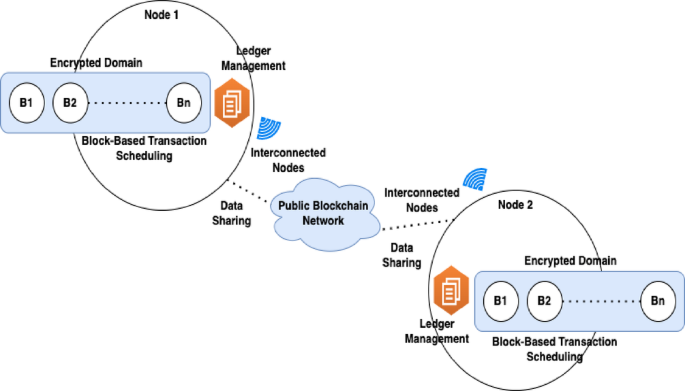
In order to address such mentioned challenges, Blockchain Technology (BT) has been raised as a transformative solution for securing, organizing, managing, and optimizing wearable health data, as shown in Fig. 1. It is due to offering decentralization, forged-resistance facilities, transparency, and secure infrastructure that mainly eliminates the need for intermediaries of centralization. However, the current integration of smart contracts enables automated access control and protected data exchange, which ensures that only authorized entities can access patient records. In addition, Zero-Knowledge Proofs (ZKPs) improve privacy concerns by improving data verification and validation, which means it cannot reveal sensitive information without permission. Thereby preserving patient confidentiality, integrity, provenance, and immutability. Throughout this, BT’s immutable ledger ensures that once health data is recorded, it cannot be manipulated or changed which significantly enhances trust and makes a trustworthy environment, where gaining reliability twice a time as compared to the centralized platform, especially for healthcare applications.

Multidisciplinary DApp Involvement.
Nevertheless, various research has illustrated the effectiveness of BT-enabled solutions in enhancing security, reducing operational costs, and enhancing patient trust, especially in the healthcare environment, as shown in Fig. 2. The Distributed Application (DApp) of BT in wearable health monitoring remains an emerging area of research, with different limitations related to computational overhead, latency, throughput, and energy efficiency, which still requiring optimization.
Motivation and research questions
It is worth noting that the increase in the prevalence of the aging population, chronic diseases, and the growing rate of remote healthcare solutions, along with reliability, have accelerated the adoption of wearable health technologies. Till now, various IoT-enabled devices offer real-time continuous patient health monitoring, improve patient engagement, and early disease diagnosis, enabling healthcare providers to create data-driven decisions and improve patient outcomes effectively. Undoubtedly, despite such significant advantages, current wearable health applications face critical limitations that limit their capabilities due to scalability, effectiveness, and security.
However, IoT-enabled wearable continuously collects, transmit, and manage highly sensitive patient records, including blood pressure, ECG signals, glucose levels, and heart rate. Preserving and organizing such records in centralized systems, especially in a cloud environment, increases the risk of cyberattacks, data breaches, and control access. It is worth noting that, till now, more than 55% of healthcare data breaches have surged in recent years, exposing millions of patient records to privacy preservation threats. All such applications provide access to patients who often have limited control over how their data is preserved, exchanged, and utilized, which increases the concerning factor regarding the ownership of the data and related consent. In this manner, this paper also evaluates the biggest challenge in the current healthcare ecosystem, which is the lack of standardization in terms of communication protocols between different wearables, governmental integration, ministries, and healthcare providers. Various wearable health devices operate and help in continuous health monitoring in real-time, especially to handle data that cannot be modified or tampered with at various steps, such as leading to inaccurate diagnoses and compromised healthcare services. Such type of raising problem becomes the major motivation of this paper.

The Steps to Achieve Wearable Data Privacy and Security.
On the other side, wearable healthcare technologies generate massive amounts of real-time data, which not only requires efficient preservation but needs dynamic processing, along with analytics. Undoubtedly, the classical centralized systems struggle with scalability problems, latency, and high computational costs integrated with organizing large-scale health records. In addition, existing healthcare platforms often prioritize institutional control over patient data, which limits patient autonomy in managing their health records.
The primary motivation for this research stems from the urgent requirement to overcome current challenges in wearable health monitoring systems by collaborating with BT-enabled solutions, as shown in Fig. 3. In order to make it more reliable in terms of privacy preservation, security, interoperability, and scalability, BT-enabled wearable technologies have the potential to redefine the futuristic need regarding personalized healthcare and remote patient monitoring, as shown in Fig. 3.
Due to evaluating these highlighting prospects, this paper critically addressed the list of research questions mentioned as follows:
-
1.
Research Question #1: How can we evaluate the most effectiveness regarding the cryptographic techniques for ensuring privacy protection, preservation security, and control access reliability in BT-enabled healthcare data exchange?
-
2.
Research Question #2: What impact did the system receive while integrating the edge computing and BT on the real-time process?
-
3.
Research Question #3: What challenges are going to receive while implementing BT interoperability standards across different healthcare institutes and the role of IoT?
Based on the identified current limitations, this paper aims to answer the following questions in the next subsection as follows:
Contributions and outline of the study
The major contribution of this paper is discussed as follows:
-
This paper design and create a BT-enabled framework for wearable health monitoring that ensures secure, private, an efficient data management.
-
The proposed work implements smart contracts for automated access control, authentication, and secure data exchange.
-
This paper improves privacy preservation, protection, and security using ZKPs to enable verifiable yet confidential integrity while data sharing and exchange.
-
Due to such integrational implication, this solution improves data integrity and system reliability, which helps in achieving 93.33% enhancement in security and trustworthiness.
-
This paper ensures scalability and real-time processing efficiency, which address the limitations of classical centralized frameworks.
The remainder of this paper is aligned and organized as follows: Sect. Related work examines state-of-the-art previously published papers on the topic of BT-enabled healthcare solutions and related developments. Section Mathods and material discusses the methods and material utilized to propose the problem formulation. Section Proposed framework presents the proposed framework and its key components. Along with that, the section discusses experimental outcomes and evaluates the performance of the proposed framework. However, Sect. Implementation challenges and open research issues explores implementation challenges raised during the design and deployment. The list of derivations regarding future research directions is also included. Finally, this paper concludes with the statement of conclusion and future direction in Sect. Conclusion and future direction.
link