Impersonator Used AI to Mimic U.S. Secretary of State Marco Rubio’s Voice in Calls to Officials
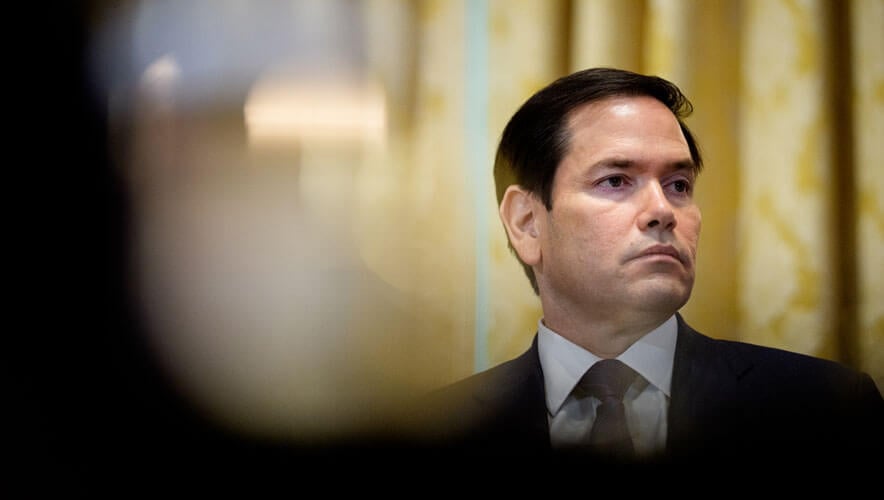
WASHINGTON, DC – 8 JULY: U.S. Secretary of State Marco Rubio attends a cabinet meeting with U.S. President Donald Trump at at the White House on 8 July 2025 in Washington, DC. (Photo by Andrew Harnik, Getty)
Impersonator Used AI to Mimic U.S. Secretary of State Marco Rubio’s Voice in Calls to Officials
9 July 2025
Today in Security
An imposter used artificial intelligence (AI) to mimic U.S. Secretary of State Marco Rubio’s voice when contacting at least five high-ranking government officials.
The U.S. State Department issued a cable on 3 July to notify its employees about the impersonation. The Washington Post obtained the cable, which revealed that U.S. authorities have not identified who is responsible for the impersonations. But the Post reports that they suspect the effort is an attempt to manipulate powerful government officials “with the goal of gaining access to information or accounts,” according to the cable.
The impersonator contacted three foreign ministers, a U.S. governor, and a member of Congress via text or voice messages on Signal.
“The sender used the display name [email protected], which is not a functional email address, as their Signal nickname,” NBC News reported.
The department said it is taking steps to improve its cybersecurity posture, but it declined to comment to other media outlets further on the investigation into this latest impersonation effort.
“This fraud highlights how deepfake technology has matured beyond easily detectable viral videos into seamless audio and text deception,” said Leah Siskind, an AI research fellow at the Foundation for Defense of Democracies, in a release shared with Security Management. “We’ve seen other instances of deepfakes of senior government officials used to gain access to personal accounts, but leveraging AI to influence diplomatic relationships and decision-making is a dangerous escalation. This is an urgent national security issue with serious diplomatic ramifications.”
Rubio is a known to use Signal, a messaging platform that is popular with U.S. foreign officials, journalists, and foreign policy analysts, according to The New York Times. His use of the application was previously highlighted when Editor-in-Chief of The Atlantic Jeffrey Goldberg reported being mistakenly added to a Signal chat that included Rubio and was used to discuss a U.S. bombing campaign in Yemen.
This is not the first time someone has impersonated a high-profile U.S. official. In May 2025, someone was able to access White House Chief of Staff Susie Wiles’s phone contacts to call and message legislators and business executives from an alternative number while pretending to be her, the Wall Street Journal reported. One year prior, a deepfake video of the State Department’s spokesperson, Matthew Miller, was circulated online.
“Hany Farid, a professor at the University of California at Berkeley who specializes in digital forensics, said operations of this nature do not require sophisticated actors, but they are often successful because government officials can be careless about data security,” the Post said.
Siskind agreed, noting that audio deepfakes are very easy to generate.
“With just 30 seconds of recorded audio, an adversary can create a convincing audio clip impersonating someone else,” she said. “Given how frequently our senior officials speak in public, this means anyone could be at risk of similar scams.”
link