




Cameron Kaiser
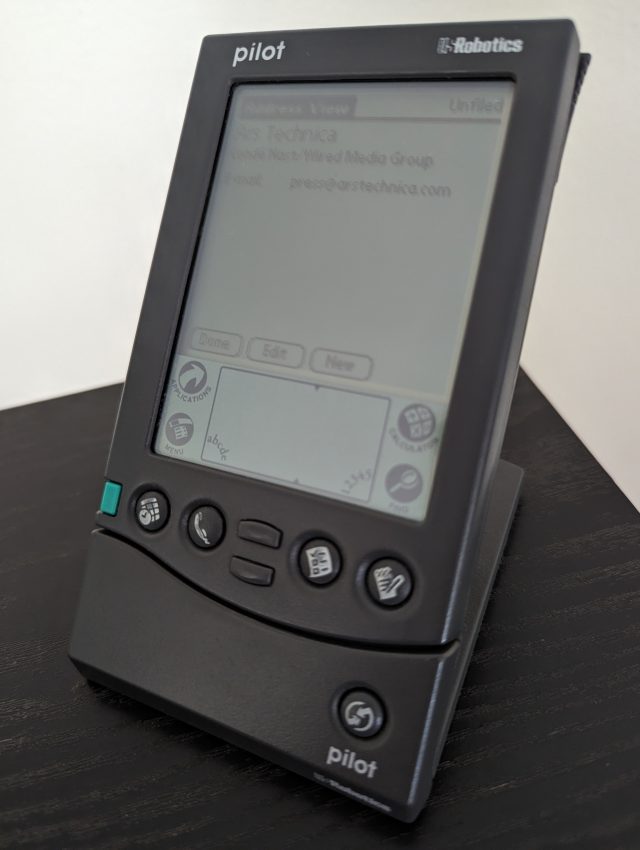
The Pilot 1000 in its cradle, with an important address.
Cameron Kaiser
Cameron Kaiser
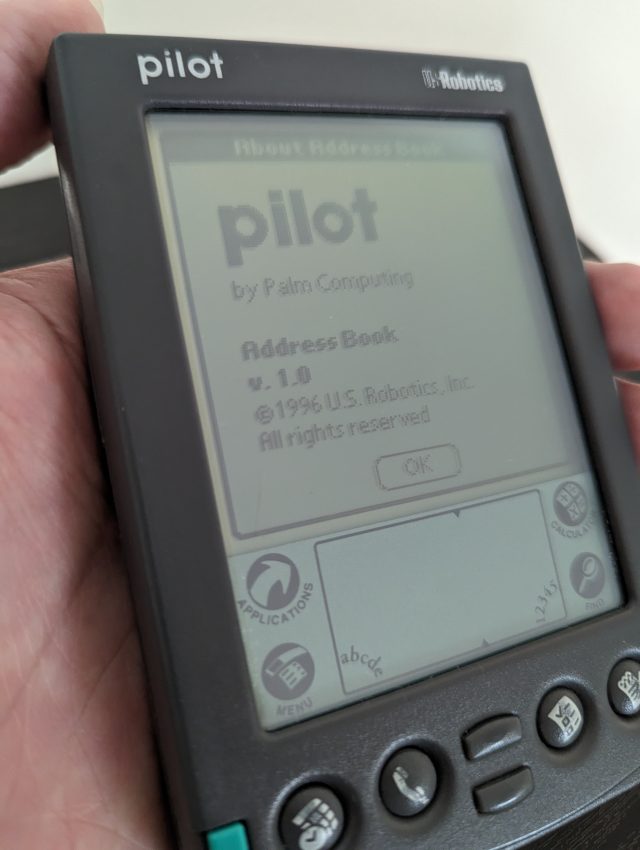
The About screen from the Address Book, showing “Pilot by Palm Computing” version 1.0, copyright 1996 US Robotics.
Cameron Kaiser
The Pilot 1000 in its cradle, with an important address.
Cameron Kaiser
The About screen from the Address Book, showing “Pilot by Palm Computing” version 1.0, copyright 1996 US Robotics.
Cameron Kaiser
In the box was a manual, cradle, and software. For connectivity, PalmConnect’s spiritual successor was a new, broader personal information manager (PIM) called the Pilot Desktop, provided in the package as 3.5-inch floppy disks. However, aware that many users would already have a PIM client they preferred, contractor IntelliLink (later Intellisync) separately provided “conduits” to many of the major players of the day, like Microsoft Schedule+ and, in particular, Lotus Organizer.

Credit:
Cameron Kaiser
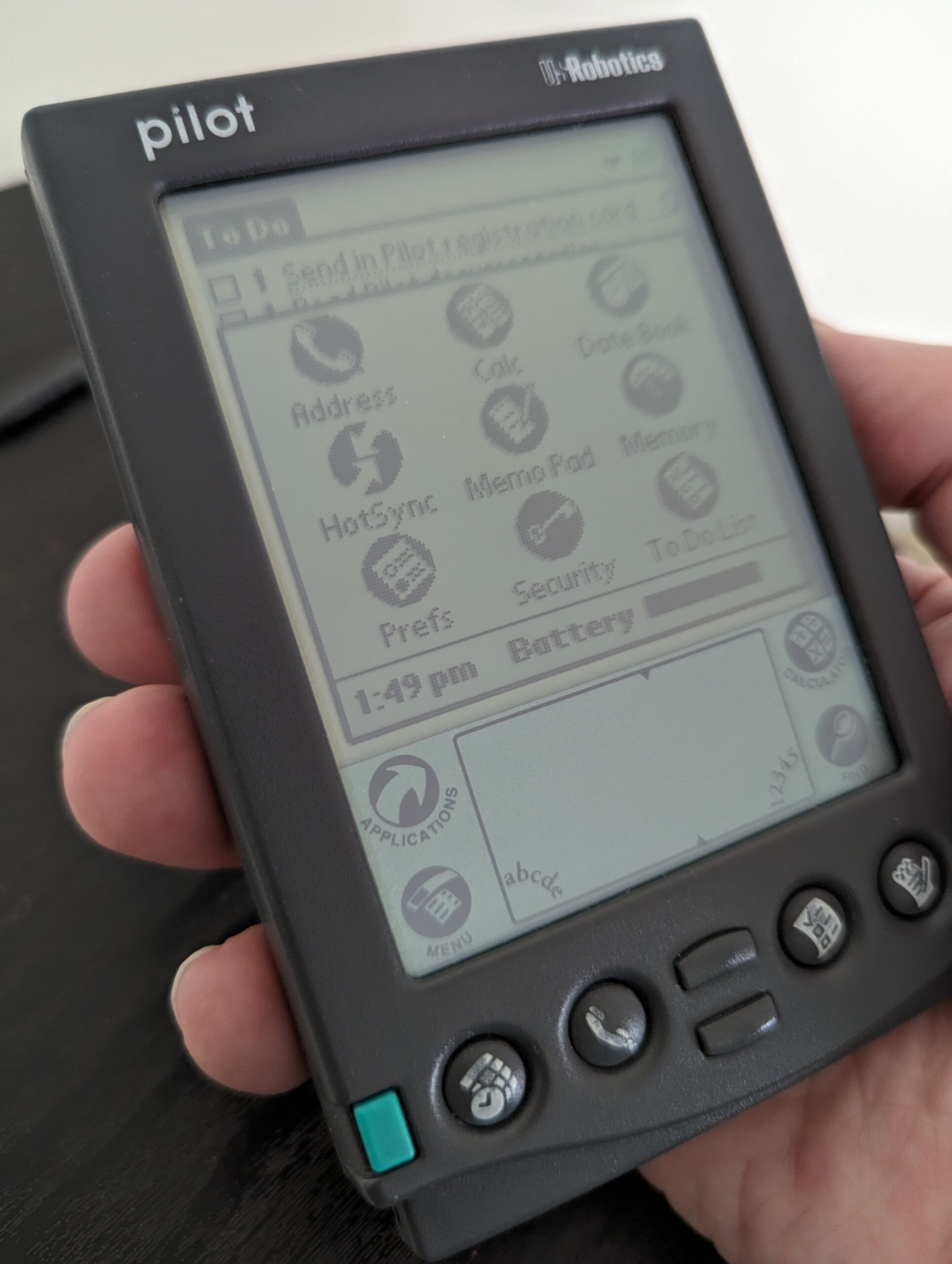
A “pop-up” launcher greeted users of the original Palm OS instead of a separate launcher application.
Credit:
Cameron Kaiser
Every Pilot came with a standard set of PIM applications in ROM. These initially included the Address, Calc(ulator), Date Book, Memo Pad, and To Do List, supported by the Hot Sync, Memory, Prefs, and Security apps. These synchronized data with the Pilot Desktop and backed up and protected on-device data and software. Aside from relatively modest changes, these applications appeared in some form on every subsequent Palm OS device until the bitter end.
While Palm OS 1.0’s front end was a new and unique interface, its underlying operating system originally came from off the shelf. In 1978, Canadian engineering company KADAK developed a real-time operating system kernel for minicomputers operating oil and gas pipelines. By the early 1980s, its real-time operating system, named AMX, was cross-platform and expanding into new markets. As an example of its sophistication, Computerworld in 1984 remarked on an Intel 8085-based (not a typo, not an 8086) multiuser computer system using AMX as the kernel overlaid with additional custom software. It came with 80K of memory, floppies, and a 10MB hard disk and could serve up to 255 workstations with their own disks and printers over a custom 848Kbps network.
Crucially, AMX also supported the 68000 family. It provided real-time preemptive multitasking, scheduling with adjustable priorities, message passing, message queues, and semaphores, along with interrupt and dynamic memory management. In the Pilot, a low-level ROM routine ran at startup to initialize the hardware and then transferred control to AMX, or what Palm called the “microkernel.” Using AMX as the core of Palm OS gave Palm’s engineers a way to get an established, well-tested system foundation up quickly, but it belied little of AMX’s advanced capabilities because Palm’s license came with a serious caveat: The API to create tasks could not be exposed to user software. User applications thus could not add tasks of their own, though system software could, such as HotSync creating a separate thread to manage the serial connection.
link